We recently picked up one of those Aquasaurs kits for the kids – which lets you hatch and care for some neat little aquatic fish (or shrimp) that date back to pre-historic times.   After reading the instructions we got everything set-up and all was good,  until we read the part about the temp of the water needing to remain between 72 – 80F.   Problem is, we tend to keep our house around 70ish, and during the day, we have our automatic thermostat drop the temp to more frigid temps (to conserve you know!).  We quickly realized that these things would likely not get past the larvae stage at those temps.  For the first two days, we had the tank propped up on the stove under the halogen lights to keep the water warm. However, over time, they would heat the water too much and need to be monitored / turned off for periods of time.  We needed to come up with a longer term solution.

One option would be to simply go out and drop $$ (insert cost here – I don’t know) on a aquarium heater – but that would be too easy.  I’d rather take my $300+ extra NXT & temperature sensor and make them work for a bit.    Now you ask yourself, how the heck would the NXT heat the water.  Well, that’s where dSwitch from Dexter Industries comes in. Interestingly enough, the dSwitch did not come to me with the intent of using it to heat the Aquasaurs tank. It was more like irony and good timing that I just received the dSwitch and we got the Aquasaurs going.

Read More >>

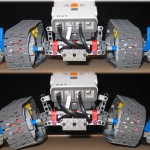
Sometimes I build robots that attempt to solve real world challenges.  Other times, robots are built based on random ideas. This robot is a case of solving a LEGO challenge – specifically, with their Technic tracks/treads #575518.  At no fault of theirs, these plastic tracks are slippery on many surfaces.  Great for carpets, flat areas, dirt (if you dare) – and great for turning as well.  However, when you try to climb with them, they are as slick as ice.


If you Google them, you will find some great ideas on making these treads more ’sticky’.  Some have used 1/2 Technic pins (which fit nicely into the supplied holes), others have used elastics wrapped around them – all great ideas that work fine.  I attacked the challenge from a different angle.  The result is DG – or Dual Grip (yes, the name is somewhat plain).  DG went through numerous revisions as I worked out kinks related to weight, stability, traction, sensors, flex etc.  At the bottom I have included some pictures on previous versions of DG – some changes significant, others subtle.


The idea was to have a treaded robot that could navigate varying terrain, turn quickly and of course, climb.  Based on my experience with my other robots using the same tracks (eg UNV and DynaTrax), I found that they were not very good when it came to inclines.  I figured that the LEGO rubber wheels have great traction on most surfaces, so why not slap a set of them along with the treads.  However, this posed another challenge.  I did not want both wheel systems in contact with the ground at all times as this would make turning tougher and be redundant.

Read More >>

I recently decided that it is about time to replace my old P4 server in the interest of speed, space and power reductions. Even with a P4, this sever is heavily underused.  My choice was a mini-ITX form factor system running the Intel Atom N330 Dual Core processor.  Although there is little improvement over CPU speed, I also migrated to an OCZ Indilinx SSD.  That’s a little background for you.  Now, my existing machine is my web/db server and is running Windows 2000 (yes, I realize its a 10yr old OS, but its working just fine for my purposes), SQL Server, MySQL, IIS5 and PHP.

Read More >>